WritersPrintshop gets you published

Use the Browse button to inspect contents of most books using Google Print

A Sumerian Observation images


The website for writers
WritersServices has over 2000 pages packed with help for writers
To help you find
Search
Contents
FAQs
Amazon UK       Amazon US

Some extracts from the book

The incoming path of the trajectory over approximately the last second of its flight is shown in Figure 33. It can be seen that the Köfels object flew almost perfectly parallel with and slightly to the east of the ridge ending in Gamskogel. Figure 34 (left) shows the corresponding profile of the terrain over the last 15 km of flight and it is clear the object interacted with Gamskogel clipping the ridge to give a 2 kilometre long cut with a 6 degree slope, matching the incoming trajectory.


Figure 38: Felderkogel


Other impact sites are known to have associated secondary impacts from fragments that have broken off during the atmosphere flight. These secondary impact sites form in an ellipical pattern with the primary impact at the furthest point and the smallest fragments at the other end, the gradation due to the fact that smaller objects will be more influenced by aerodynamic drag [24].
Figure 38 shows a suggestive feature on the side of Felderkogel on the opposite side of the valley from Gamskogel (Figure 33). It has the form of a classic impact crater and it is in a position that is consistent with an object on a parallel path to the main object. The feature is around 250 m in diameter which would correspond to an object a few tens of metres in diameter and in itself would have been a bigger impact event than the 1908 Tunguska impact.


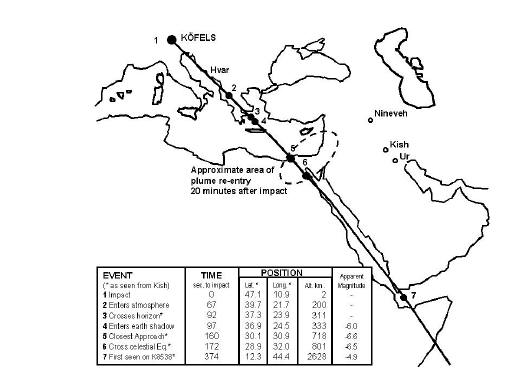
Figure 25: Ground Track of Köfels Object

....

Thus we know the path across the background stars and the approximate observers azimuth to the point of closest approach. This ties down the flight path angle and azimuth quite well to approximately -6º (±0.5º) flight path angle and approach to Köfels from an azimuth of 132º (±0.5º). These two parameters are linked when trying to maintain a reasonable fit to the path through Enif and Altair, but the point of closest approach is largely determined by the azimuth. Assuming the trajectory given by case 9 the azimuth of closest approach is 258.2°, about 39% of the separation from Enif to Altair. This is a very good fit with K8538. The ground track of Case 9 is shown in Figure 25.


This image by Amanda Pollard visualises the 'shooting star' which might be associated with subsequent events such as the destruction of Sodom and Gomorrah.

The Preface to A Sumerian Observation of the Kofels' Impact Event

Amazon UK       Amazon US

For several years we have been conducting research into the possibility of a major Near Earth Object impact in the Early Bronze Age. While this was not in itself an original hypothesis, our interest was in exploring whether Köfels in Austria could have been the site for such an event which, to the best of our knowledge, was a conjecture that had not been considered before. When we started the project this premise was highly speculative and the work was done for our own intellectual stimulation rather than in any expectation of reaching any conclusive, let alone publishable, results. However the tone of the project changed when our attention was drawn to tablet K8538 (commonly called the “Planisphere”), a cuneiform text in the British Museum. There has never been a comprehensive and consistent translation of this unique tablet, but it had several aspects that led us to the conclusion that it might relate to a Near Earth Object impact and on the basis of this impression we undertook to examine it in detail.
We had two advantages over previous researchers who have tackled K8538. The first advantage was that we had a clear context regarding what the tablet might be about. Context is always important when dealing with Sumerian cuneiform due to the high level of ambiguity compared with modern written languages, but it is especially important in the case of this tablet where its purpose seems to have been more as an “aide memoire” to the writer than a means of communication with other people.
It is therefore important to know that a Near Earth Object impact is an event that might have been observed. It also helps to have some experience of astronomy and understand the sort of factors that affect what could be seen and what would be of interest to an observer. We are certain that modern astronomers who follow the detail of the tablet will feel an empathy with a skilled and objective brother astronomer - even after 5000 years. Without this background knowledge understanding K8538 would be very difficult.
The second advantage we had was new software tools that were not available to any previous researchers. The programs used for trajectory modelling were non-commercial; they were modified versions of programs that had been used on a previous project. The other programs, used to model the position of stars and planets, were widely available commercial packages. When these programs were combined we could directly compare the tablet’s pictures to the actual sky. Without this ability to “see again” what the Sumerian astronomer saw, we believe understanding the tablet would be impossible and we believe this was the key problem that has prevented previous researchers fully understanding K8538.
As a result of this examination we believe our original speculation regarding the tablet was correct, that is the tablet is an astronomer’s contemporary record of a kilometre class Aten asteroid as it approached Earth to impact at Köfels in Austria. What we were completely unprepared for was the objectivity and accuracy of the observation, which gives an incredibly rich insight into the event it describes. Clearly these conclusions merited publication; hence this monograph.
We decided to report our results in a monograph for two reasons. The first reason is that the arguments are complex. There are three major interlocking areas, the tablet itself, the Köfels site, and the heliocentric orbit of the object. Each of these areas is complex in its own right, yet each is internally consistent. Then the stories they each tell individually are completely (and very precisely) consistent with each other. Thus we have jigsaws that are themselves pieces within an overall jigsaw and the proof lies in that the end result is such a clear unified picture. An argument this complex cannot be fully outlined within the word constraints of a journal paper whereas in a monograph we can both present the full arguments, and cover some of the secondary material, needed to establish the veracity of our contentions.
The second reason for using a monograph to report this work is that it is highly multidisciplinary in nature and this creates problems for a conventional journal paper. Academic journals are focused on specific subject areas with specialist editorial boards, and specialist referees to review the papers submitted. Not surprisingly, editors and referees have difficultly handling papers that have substantial content outside the journal’s field and yet which form an essential part of the argument. This problem then extends to the readership of a journal, which is also restricted to specialists in one subject rather than the totality of people who would have an interest in the work. A book enables us to engage all the potentially interested communities on an equal basis, even if we have lost the advantages of peer review.